
Thomas Browne: Divine Miscellany
The great polymath on urns, worms, and redemption through learning

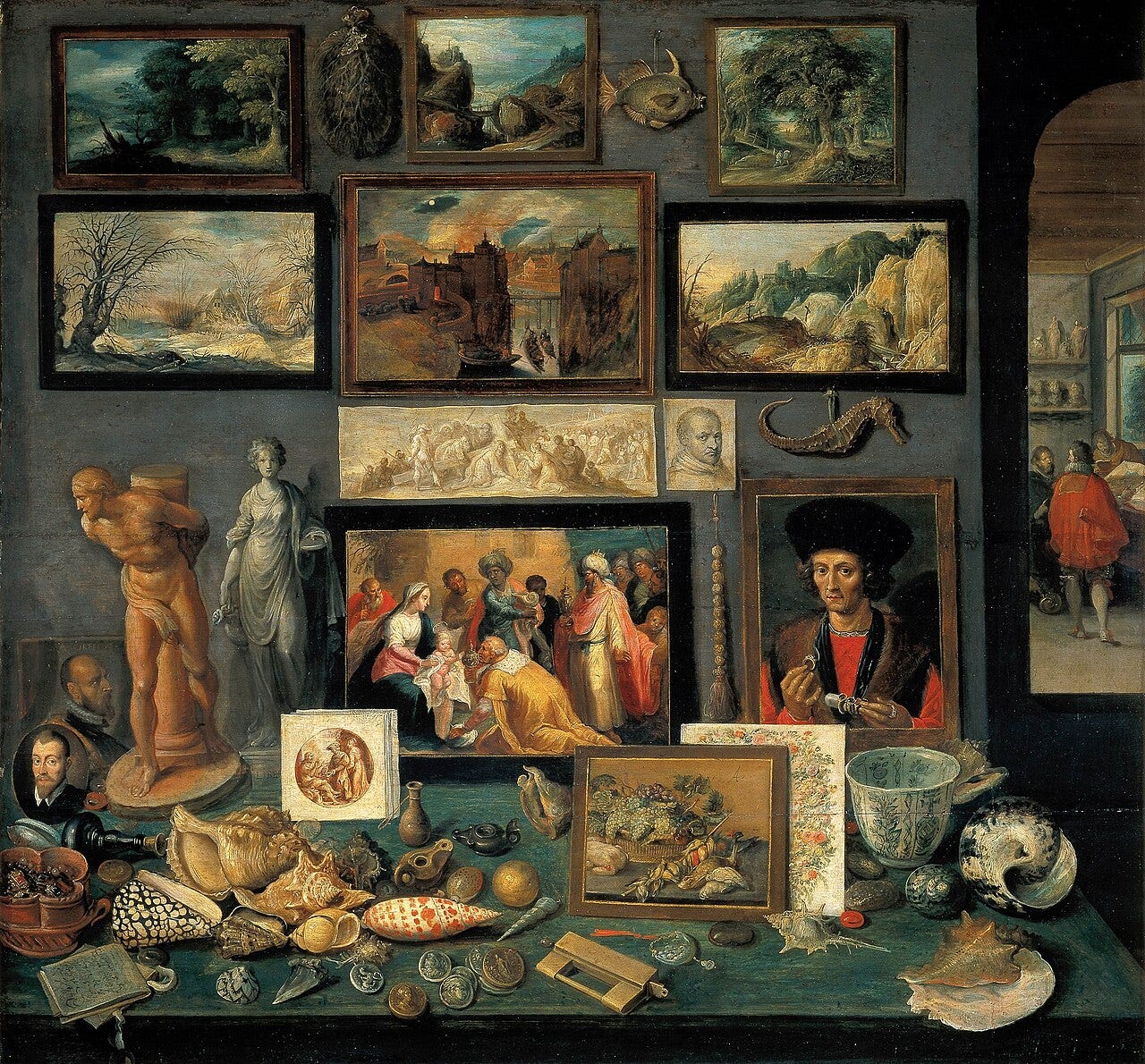
Happy are they whom privacy makes innocent, who deal so with men in this world that they are not afraid to meet them in the next, who when they die, make no commotion among the dead.
– Sir Thomas Browne, Urn-Burial, or, A Brief Discourse of the Sepulchral Urns Lately Found in Norfolk
Thomas Browne was an uncommonly curious mind, living in a world that was ripe for curiosity. Born in 1605, the son of a Cheapside merchant, Browne studied on the Continent and practised as a doctor in Norwich, while dedicating his spare time to writings that span a fantastical range of subjects, from the causes of thunder to the sex life of worms. Though I’m far from expert in his works, I consider him a kind of hero: for his extraordinary intellectual appetite, for his dignified commitment to the life of the mind, and for the sad, melodious air of reflection that flows through his prose.
Browne’s life was a historical estuary, a tidal space where different eras overlapped and mingled. The scientific revolution was gathering pace, but the cosmos was still infused with religious significance. The barriers of medieval thought had broken down, but the compartments of modern knowledge had not yet taken shape. The English language was in a protean phase, there for the artful writer to forge into rich and wonderful forms. Experiment and theory, classical erudition and modern scepticism, scientific and humanistic enquiry still belonged to a single, chaotic sphere of learning. The freedom with which Browne surfed these various currents makes for a sad comparison with the narrow specialisms of our own time. As Claire Preston writes, introducing her excellent selection of Browne’s works, his output is “like an archaeological core sample of the varied strata of seventeenth century intellectual concerns.” Anatomy and chemistry, theology and numerology, astronomy, anthropology and ornithology were all fair game to the polymath.
In his famous essay Urn-Burial, Browne responds to the discovery, “not many months past,” of a trove of Anglo-Saxon burial urns in Norfolk, “deposited in a dry and sandy soil not a yard deep… containing two pounds of bones, distinguishable in skulls, ribs, jaws, thigh-bones, and teeth, with fresh impressions of their combustion.” These morbid findings inspire Browne to launch a meandering discussion of funerary customs in different cultures, replete with historical speculation, classical and biblical allusions, and reflections on human mortality. In a typically dry aside, he acknowledges that while the Christian faith requires burial instead of cremation, the latter is not without its advantages:
To be gnawed out of our graves, to have our skulls made drinking bowls, and our bones turned into pipes to delight and sport our enemies, are tragical abominations escaped in burning burials.
The enduring wonder for Browne is that the forces of nature and history should have preserved something so modest and anonymous. “Time which antiquates antiquities and hath an art to make dust of all things hath yet spared these minor monuments,” he writes. “To be unknown was the means of their continuation and obscurity their protection.”
Unravelling such mysteries was, for Browne, a religious mission. Through intellectual enquiry we might, he thought, raise ourselves up from our fallen state in sudore vultus tui, by the sweat of our brows. He often uses the word “hieroglyphics” to describe his view of nature as a divine code to be deciphered, insisting that “the finger of God hath set an inscription upon all his works, not graphical or composed of letters, but of their several forms, constitutions, parts, and operations.” This outlook was widespread among the natural philosophers and experimenters who laid the foundations of modern science during this period.
People sometimes talk about the “low-hanging fruit” on offer in ages when little was really known about the world. Whereas making a fresh discovery now requires years of research, it used to be a case of simply looking around and taking note of what you see. The problem is that new information only appears significant or useful in light of what we have already learned, so early observers did not always know what they were looking for. Hence Browne’s superb list of “things to be investigated,” jotted in a notebook, and including the following:
Whether it be general that lepers have no lice.
Whether great-eared persons have short necks and long feet
That if a woman with child looks upon a dead body the child will be pale-complexioned.
That to make urine upon the earth newly cast up by a mole bringeth down the menses.
Why a pig held up by the tail leaves squeaking?
With the breadth of his reading and investigations, Browne made miscellany a method unto itself. He wrote a work called Pseudodoxia Epidemica, a kind of encyclopaedia of errors that he had identified in different fields of knowledge. Commenting on sexual intercourse in the animal kingdom, for instance, he observes that “nor is there one, but many ways of coition, according to divers shapes and different conformations.” As Browne explains, “some couple laterally or sidewise, as worms; some circularly or by complication, as serpents; some pronely… as apes, porcupines, hedgehogs.” But whereas all other creatures copulate in a single position, he adds regretfully, “only the vitiosity of man hath acted the varieties hereof.”
Browne also lived at a dangerous time. In the mid-seventeenth century, England experienced civil war, regicide and restoration, convulsions that brought not just political breakdown and violence, but intense religious conflict in the realms of culture and ideas. And yet, he stood back from the vortex. His works show barely a trace of contemporary political and ideological quarrels, except for the occasional plea for civility in intellectual discourse. As Browne writes:
I cannot fall out or contemn a man for an error or conceive why a difference of opinion should divide our affection; for controversies, disputes, and argumentations, both in philosophy and in divinity, if they meet with discreet and peaceable natures, do not infringe the laws of charity.
He goes on to warn that “passion” leads us astray in debate, “for then reason like a bad hound spends upon a false scent and forsakes the question first started.” I take this to be not an expression of naïve, “can’t we all just get along” centrism, but a recognition that the highest goods culture has to offer, knowledge among them, can only be properly pursued if we leave our sensitivities and pridefulness at the door. Something, perhaps, that we could reflect on in turn.
More than anything it's the sheer beauty of his prose that repeatedly brings me back.
Thank you for this fine introduction.