
Odyssean Wiles
Design, cunning and deceit

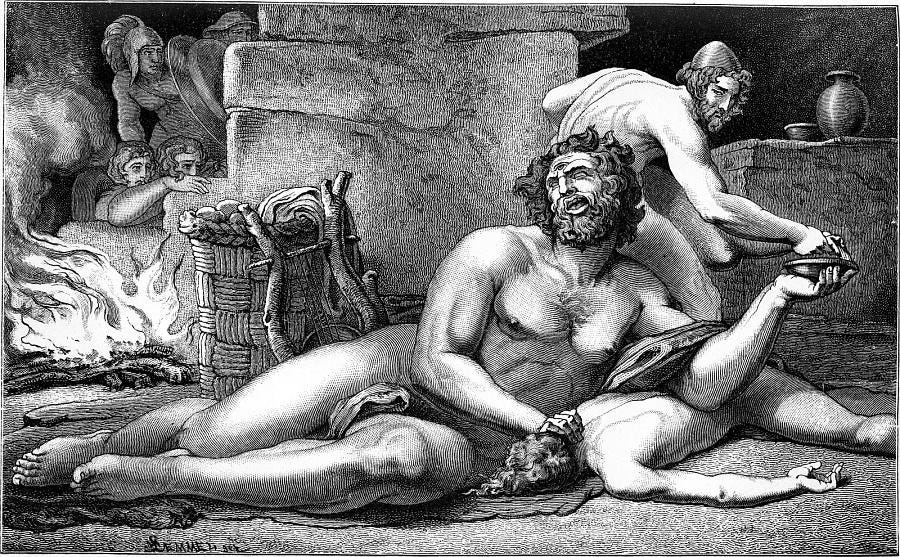
I didn’t think very much of Christopher Nolan’s adaptation of the Odyssey. Still, it’s not very often that a foundational text of Western literature is at the centre of public conversation, so I’m not going to miss my chance to chime in. What, you may ask, does this story have to do with design? Quite a lot, I think; at least in the original Homeric version. One of the disappointments of Nolan’s film is that the depiction of Odysseus has so little in common with the character described by Homer. Odysseus was one of the earliest, and perhaps the most vivid, examples of a heroic problem-solver. He embodied attributes which the modern designer is eager to be associated with.
The crucial quality here is metis, meaning guile, cunning and resourcefulness. According to Homer, Odysseus is polymetis, a man of many wiles. (Other epithets of similar meaning are polymekanos, polykerdes and polytropos). Metis is manifest in the countless ruses that Odysseus is always coming up with to extricate himself from hairy situations, such as protecting his identity from the cyclops by giving his name as “no-one” (a detail skipped by Nolan), disguising himself as a beggar to observe the goings-on in his home, and, of course, devising the Trojan horse ploy. The use of ingenuity to navigate obstacles and conundrums is, if nothing else, an excellent narrative principle. It explains why Odysseus’ exploits are so much more memorable than, say, the Twelve Labours of Hercules, which that hero mainly accomplishes through sheer strength and proficiency at violence. The Nolan film is a generic American action movie, but the original Odysseus is much more of a James Bond figure.
What makes the metis of Odysseus especially relevant to the designer is its ambiguous place on the scale between practical know-how and cerebral intelligence. S.C. Hickman argues that metis is a “contextual and particular” type of knowledge, combining experience, improvisation and gut-instinct. This appears to be the quality we hear prasied in the Iliad, the other surviving Homeric epic, where Nestor claims:
It is with metis rather than force that a woodcutter is better. It is with metis that a helmsman over the wine-dark sea steers his swift ship buffeted by winds. It is with metis that charioteer is better than charioteer.
These examples suggest a subtle mastery or “feel” demonstrated by creative and experienced individuals in a particular domain, whether wood-cutting, sailing or chariot-racing; perhaps a complement to techne, the more formal knowledge associated with an art or skill. But Odysseus, like the modern designer as an ideal type, is notable for his ability to apply his practical intuition to whichever problem he is presented with, and to do so from a more detached, calculating perspective. He is less of a craftsman than a crafty man.
Many have pointed out that Nolan’s film transfers the Odyssey into a much more Christian moral universe, presumably to make it feel familiar to a contemporary audience. So maybe his Odysseus is shorn of metis because, to modern eyes, this quality would be indistinguishable from deceit, and not especially admirable. Most of Odysseus’ ploys involve outsmarting his adversaries by dishonestly disguising one thing as another thing. This is part of the reason that, in their 1940s Marxist tract Dialectic of Enlightenment, Max Horkheimer and Theodor Adorno presented Odysseus as a prototype for the exploitative capitalist, a kind of dodgy businessman who finds loopholes in the fine print. From the ancient Greek perspective all of this looked quite different, because the cunning of human beings could never be more than a local and ultimately futile initiative in a universe where the overwhelming rule was helplessness before the capricious workings of higher powers. Note that all Odysseus’ metis does not spare him from a remarkably sad and cruel ordeal, while there is no question of his reaching home without divine assistance.
Nonetheless, the moral ambivalence of metis helps to explain the note of suspicion which surrounds design today; an association we see in the use of “design” to mean a plot or ploy. Often, our first reaction to seeing a clever new product or idea is, “what’s the catch?” But as the essayist Vilém Flusser observed, there is something deceitful about even the most pragmatic uses of design, insofar as these mean outsmarting the apparent constraints of nature: “A machine is a device designed to deceive; a lever, for example, cheats gravity, and ‘mechanics’ is the trick of fooling heavy bodies.” One could say that modernity itself is a great Odyssean scheme to lever our species into a position of power that, as many people still vaguely feel, is an affront to the gods.
That's a very interesting perspective!
I'll remember that.