
Can We Put Limits on Design?
Radical transformations of Earth and human nature are on the horizon

For Ray Kurzweil, principle researcher at Google, humanity is a design problem. The abilities that evolution has endowed us with may have served us well enough for the past ten-thousand generations, but they are rather puny compared with what they could be. As Kurzweil writes: “A combination of AI and the nanotechnology revolution will enable us to redesign and rebuild – molecule by molecule – our bodies and brains and the worlds with which we interact.” He looks forward to the day when hundreds of billions of nanobots will roam our bodies, repairing damaged cells and preventing illness from emerging. Our brains “will eventually become more than 99.9 percent nonbiological”, as we augment its tissues and connect them to computers.
Eventually, our bodies will become heavily modified, temporary hardware platforms, from which the information comprising our minds can be downloaded and stored elsewhere. Kurzweil concludes: “In the 2040s and 2050s… we’ll be able to run much faster and longer, swim and breathe under the ocean like fish, and even give ourselves working wings if we want them. We will think millions of times faster.”
This view is extreme even among Silicon Valley’s glazed-eyed tech boosters, but it illustrates a basic historical point. In the modern world, we give a far greater scope to our powers of design than most of the societies that came before us. Arguably this is what makes us modern. Yes, we have always been designers; the first human being who looked at the stuff of nature and imagined arranging it differently was engaging in design. Some exceptionally powerful and centralised states, like those of certain Chinese Emperors and Egyptian Pharaohs, carried out astonishing projects of social engineering and architecture, driven by cosmological visions that make Kurzweil’s fantasies seem mundane. But if these projects had greater ambitions for the next life, they were more limited in what they imagined for this one.
Until quite recently, very few people enjoyed the authority and the stability, let alone the tools, to think about changing the world beyond relatively narrow limits, at least by modern standards. Nor, in many cases, would they have felt entitled to. Icarus, like Kurzweil, dreamed of giving humanity “working wings”, yet this idea seemed quixotic enough to serve as a fable, and one whose message was to beware the dangers of too much ambition.
The modern era is different. We are constantly reckoning with schemes, plans and projects that seek to expand the domain of what human beings consciously control, whether for private gain or some vision of the greater good. We may oppose them on their individual merits, we may find their ambition arrogant and reckless, but any notion of there being a divinely mandated order of things, an arrangement of nature and society which should be preserved on principle, has been in retreat since at least the French Revolution. It may be that our appetite for design has grown with our technological power, or it may have happened the other way round. But the two have grown together, and this raises the question of whether we should place limits on our reshaping of the world, or whether we even can.
Two frontiers of design have especially profound implications for our fate as human beings. One is our home, Earth, and the other our nature, as manifest in our bodies and minds. Kurzweil’s dream of human augmentation remains unrealised, but the prospect of engineering our genetic makeup is already here. In 2019, Chinese scientist He Jiankui was sentenced to three years in prison for illegally altering the genes of three human embryos, people who have now been born. CRISPR gene-editing therapy, which involves rewriting patients’ genetic code, has been widely approved as a treatment for certain blood disorders since 2023. A number of American biotech companies have claimed that their methods for screening embryos could be used to predict characteristics such as height and intelligence; this remains contested, but the advancing power of algorithms in pattern recognition will surely have implications for genetic screening. Others are exploring techniques for “germline editing”, which would see changes introduced to embryos being passed on to future generations.
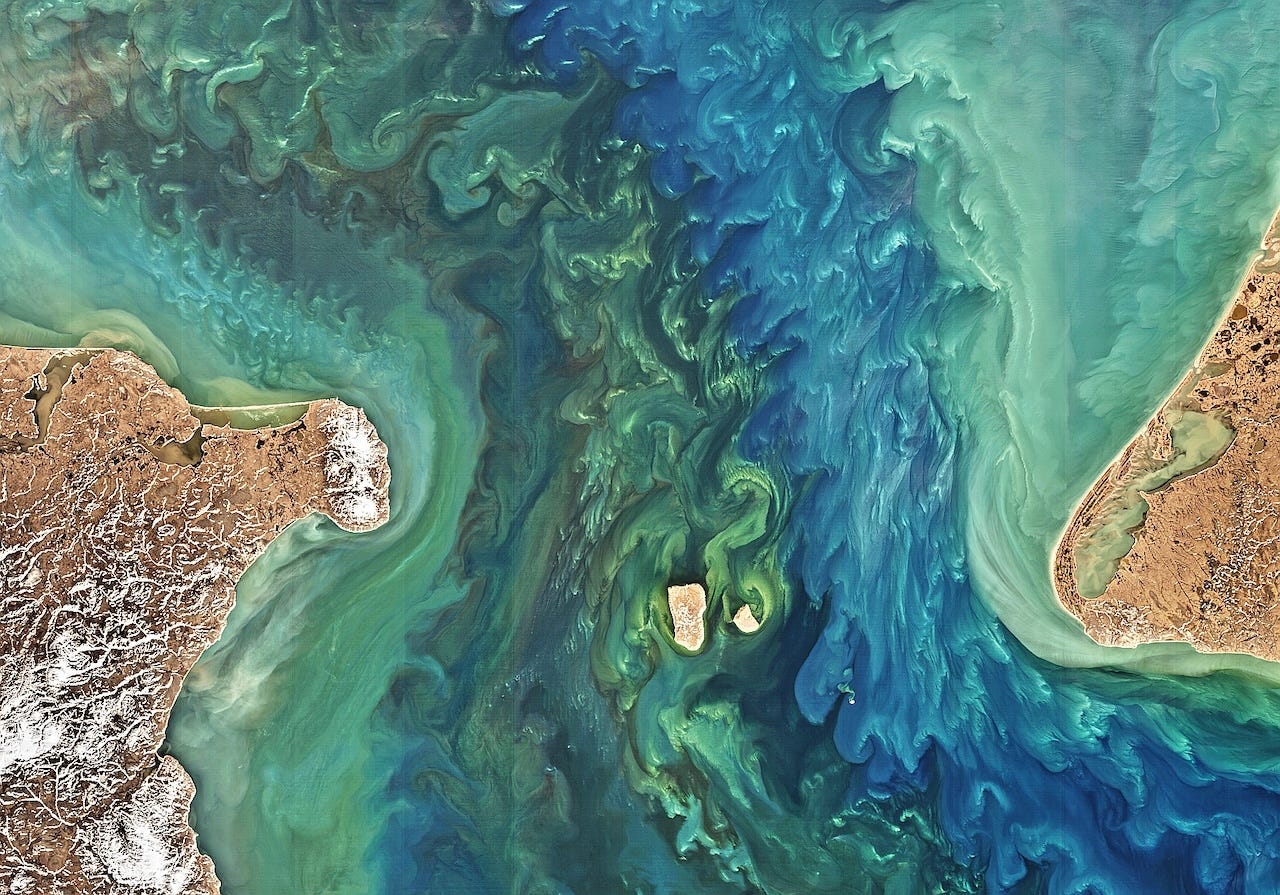
Ambitions to redesign the planet continue to grow as well. Researchers at Utrecht University have modelled the idea of building a dam more than fifty miles long across the Bering Strait, the stretch of water between Alaska and Siberia, to prevent the further weakening of the AMOC ocean currents. The failure of these currents, which help to regulate the planet’s weather systems, is often discussed as a climate change doomsday scenario. Scientists are exploring various other proposals to mitigate global warming through geo-engineering, such as dousing clouds with sea salt to make them reflect more sunlight away from the Earth. Meanwhile, tech entrepreneurs eye up the uninhabited vastnesses still remaining on and around our planet as sites for energy and computing infrastructure. The US firm Panthalassa, for instance, wants to populate the oceans with floating data centres. In the words of venture capitalist Pete Thiel, who is the backing the company, “the future demands more compute than we can imagine. Extraterrestrial solutions are no longer science fiction.”
So where, if anywhere, do we draw the line? Should we stop parents from enhancing their children’s genes, and do we make an exception for measures that help to ensure general health? What, then, about increasing lifespans? And where along the spectrum of interventions in our earthly habitat do we say “enough”? Is it just a question of risk, or are there principles from which we can deduce such boundaries?
Generally speaking, I believe that reflecting on limits is necessary and important. There is no reconciling ourselves to our condition as human beings without accepting that we are mortal and imperfect creatures, with a life of finite duration in a world of a given character. There are things which we do not, and cannot choose: we will never find peace, let alone happiness, if we don’t recognise this. Of course, this is a broad background picture. Within it, there are many areas of life – sport, art, science, commerce – where people realise their potential and contribute to civilisation by testing the limits of what has previously been achieved. At its worst though, the technology-centred culture that figures like Kurzweil belong to appears obsessed with breaking limits just for the sake of it. Much as a workaholic can’t take a day off in case he begins to reflect and realises his unhappiness, this ideology compensates for its lack of a deeper purpose by treating its ability to transform the world as an end in itself.
From this perspective, as Kit Wilson has written, “a world in which we didn’t at least attempt to create super-humans, didn’t at least attempt to create AI smarter than us, didn’t at least attempt to hack into our genetic code and rebuild it from the bottom up, would be insufferable — more insufferable, indeed, than a world in which billions of people died as a consequence of our trying. The scariest thing for these guys — the closest thing they have to a concept of hell — is an unchanging, static, motionless world. What would be the point?”
I suspect that secularisation has made it more difficult to believe in the moral reality of boundaries. Lacking a transcendental view of the world and our rightful place in it, secular thought tends to view boundaries as arbitrary barriers erected on the same moral plane as the desire to transgress them. There are many examples of secular resistance to design, of course, such as the opposition of certain groups to mRNA vaccines during the Covid pandemic. But looking around the world, religious communities stand out for the limits the continue to uphold on everything from diet and dress to scientific research.
Even secular people seem to grasp this. As Alex Trembath notes, progressives regarded the environmental activism of Pope Francis as enormously consequential. Naomi Klein thought it meant that “we might just stand a chance of tackling climate change.” Francis’ successor, Pope Leo, last week published an encyclical addressing the proper limits of artificial intelligence, urging his followers to recognise “the human being as a creature embedded in a network of relationships with other living beings and with all of creation.” Secular figures can, and do, make the same point, but have no higher authority to call upon as justification.
Ultimately though, the question of design’s limits, though it has immense importance for our future, is not one that we can answer. The reason, simply, is that there is no authority which could enforce such a decision, and still less one that could uphold it over time. Some groups, religious or otherwise, can maintain their boundaries, but there is no equivalent to the Pope for humanity as a whole. A Catholic anthropology is unlikely to motivate resistance to artificial intelligence in Japan, where the cultural legacy of Shintoism, an animistic religion, makes the notion of sharing the world on equal terms with non-human agents much less disruptive. Even if you think that some form of world government is possible in future – and it strikes me as highly unlikely – it surely will not have the legitimacy to force such different cultures into a single way of understanding things.
In light of this basic disunity, there will always be a tendency for someone, somewhere to push design into new territory, and if they become more powerful as a result, there will be immense pressure for others to follow suit. It was ever thus. The medieval aristocracy, whose status rested on its martial prowess in hand-to-hand combat, regarded the advent of crossbows and firearms as violations of the principle of honour that should underpin the social order. But there quickly came a point where refusing gunpowder in Europe would render a state powerless. Later, the same dynamic played out on a global scale. Societies that wanted to challenge Western power often did so by dismantling the limits inherent to their own cultural and religious traditions, whether against social mobility, secular education or commercial activity. Today there are signs of the shoe being on the other foot, as pressure builds for the European Union to relax its regulations on digital technology and carbon emissions in order to become more competitive.
If a group of people somewhere breaks the taboo against creating enhanced human beings, whether by genetic engineering or Kurzweilian augmentation, can we be confident that other parts of the world will simply accept their inferior status? By the same token, if certain boundaries are not crossed, it will likely be because the risks of breaking them are too high, as with the use of nuclear weapons since 1945, or because a project requires too much cooperation, like the proposed dam between US and Russian territory across the Bering Strait.
As John Gray wrote in Straw Dogs, doubtless overstating the case a little, “the mass of mankind is ruled not by its intermittent moral sensations, still less by self-interest, but by the needs of the moment.” Something can seem unfathomable until, through the complexities and contingencies of history, it becomes the best option available. This applies to opportunities as well as risks. You may consider the re-engineering of the biosphere an unacceptable violation of nature’s sanctity, but would you maintain that position if, as may be the case, it turns out that genetically modified bacteria can mitigate the problem of plastic pollution? A major problem with keeping design out of nature is that, since we have already caused so much damage without design, intervention may be the best form of conservation.
None of this means that it is pointless to attempt to place limits on design. There will be many cases when the stakes are not existential, and the costs worth paying. But even then, we should not expect such interdictions to continue indefinitely. For that is another way design’s dominion spreads: through the slow creep of time. Ways of reordering the world that seem novel and scary for one generation are taken for granted by the next, which pushes the boat out a little further, so that boundaries which looked clear from a distance dissolve as they are approached.
There's a "controversy" in my local area regarding a lake, which feels like a microcosm of what you're saying. The lake was a man made one, as almost all lakes are, and it is filling up with sediment to a point where it's causing problems in the ecology. The county must dredge it. The problem is that they are paralyzed wondering how to. They have been studying this problem for nigh 5 years already and can't make up their mind, seeking so many more rounds of community engagement which amounts to "just dredge it already". The contracted ecologists say there's practical problems of where the dirt should go -they had sourced a quarry that might take it as landfill but it was a "tentative" proposition, and very expensive (getting rid of the dirt in a project has always been in the US a shockingly difficult task). I wondered, why not just move the dirt around, as this is a large natural area, there's lots of these sunken divots with unhealthy bogs and could hold a few hundred thousand cubic feet. Well, said the ecologists, it'd disturb the natural area.
I think when it comes to design, there's a real resistance to understanding how artificial everything already is, so what, actually, does "more" design even mean?